Phosphate mining is a cornerstone of Morocco’s economy, but it comes with a significant environmental cost. The industry generates substantial quantities of waste, including clays, marls, and phosphate sludge, which are typically stockpiled on mine sites. These stockpiles pose serious environmental and land-management challenges, and finding productive uses for them has become a priority for both the mining and construction sectors. As the cement industry looks for alternative raw materials and lower-carbon binders, mine waste is emerging as a resource rather than a liability.
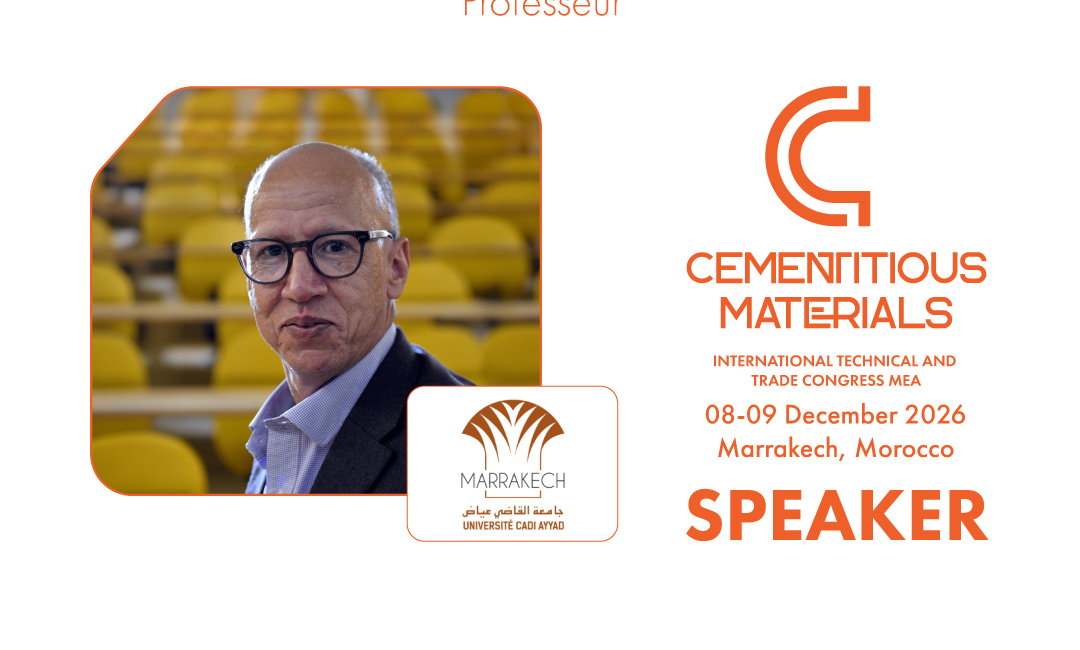
Prof. Rachid Hakkou of Cadi Ayyad University and Mohammed VI Polytechnic University will address this challenge at Cementitious Materials Morocco. His keynote highlights the potential of geopolymerization as an innovative and sustainable way to transform phosphate mining by-products into value-added materials.
His research investigated a range of activation techniques to enhance the reactivity of phosphate mine wastes, including calcination, alkaline activation, alkaline fusion, and phosphoric acid activation. The resulting geopolymer binders achieved compressive strengths of up to 62 MPa, demonstrating their suitability for construction applications.
The benefits extend beyond the building sector. Acid-activated geopolymers also showed remarkable environmental performance, achieving 98% removal of methylene blue from contaminated water. The findings show that phosphate mining wastes can be converted into functional materials for both construction and wastewater treatment, supporting the principles of the circular economy while reducing the environmental impacts of phosphate mining.
Prof. Hakkou holds a postgraduate diploma (DESS) in Subsoil Resource Development from the Nancy School of Geology in France. He earned a doctorate in Geosciences and Raw Materials from the Institut National Polytechnique de Lorraine in 1993, followed by a PhD in Waste Management and Treatment from Cadi Ayyad University’s Faculty of Science and Technology in Marrakech in 2001.
He is currently a Professor of Higher Education at Cadi Ayyad University, where he teaches the Mining Environment module in the Earth Sciences Department, as well as Industrial Chemistry and Mineral Processing in the Chemical Sciences Department. Since 2006, he has also served as an Affiliate Professor at Mohammed VI Polytechnic University in Benguerir, Morocco. His research focuses on mine waste valorisation and the development of innovative strategies for the rehabilitation of mine sites.
The Cementitious Materials International Technical and Trade Congress is the premier gathering for cement traders, industry experts, and professionals exploring the latest innovations and expanding opportunities in cementitious materials — including ashes, slags, artificial and natural pozzolana, fumes, clays, and construction and demolition waste used as alternative raw materials.
The MEA edition will take place in Morocco on 8–9 December 2026, bringing together cement producers, construction companies, ready‑mix specialists, consultants, associations, authorities, standards bodies, and traders from across the Middle East and Africa.
Contact us at contact@industrylink.eu for registration details.
Remain up to date with the latest developments by subscribing to our newsletter. Stay in touch with our upcoming events we organize and get an extra 20% off as well as extended early bird deadlines, here: www.industrylink.eu/#signupnow.