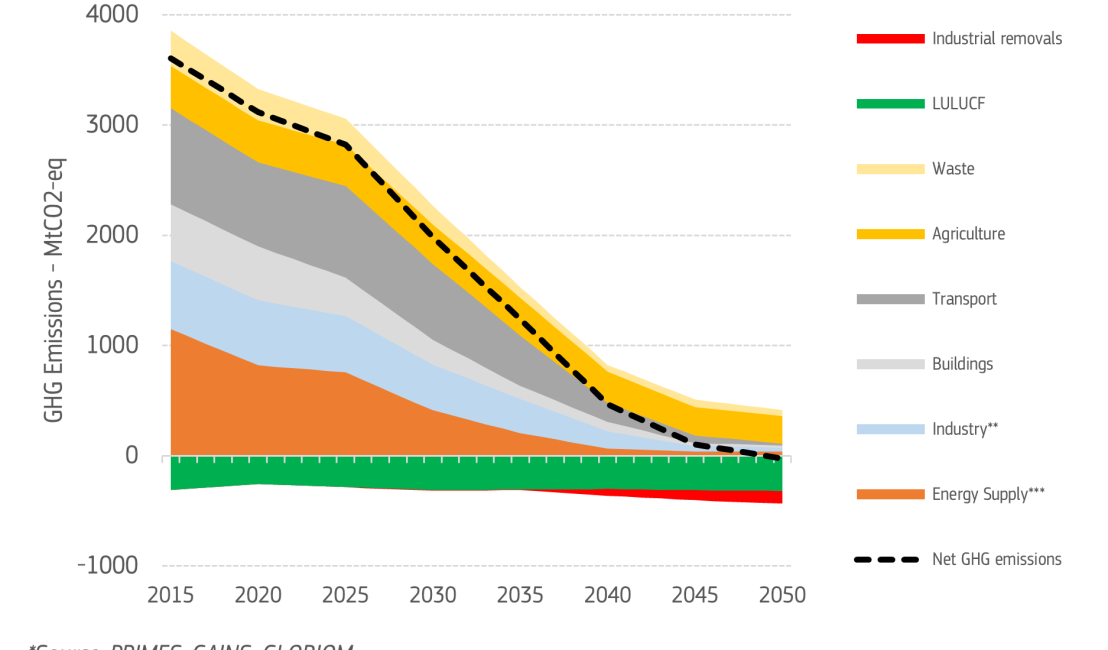
On 7 April 2026, the amendment to the European Climate Law officially entered into force, setting a legally binding 2040 target for the European Union to reduce greenhouse gas emissions by 90% compared to 1990 levels. This marked a major milestone on Europe’s pathway to climate neutrality by 2050 and strengthened long‑term planning for industry, policymakers, and investors.
The updated law reinforces Europe’s long‑term climate strategy and provides greater certainty for policymakers, industry, and investors as the bloc accelerates its transition toward a competitive, resilient, low‑carbon economy.
What the amendment includes
The revised Climate Law introduces several key elements designed to guide Europe’s decarbonisation efforts over the next two decades:
1. A binding 2040 emissions reduction target
The EU must reduce greenhouse gas emissions by at least 90% by 2040, creating a legally enforceable milestone on the path to climate neutrality.
2. A scientific foundation for future climate policy
The target is based on recommendations from the European Scientific Advisory Board on Climate Change, ensuring alignment with the latest climate science and the Paris Agreement.
3. Sector‑specific transition pathways
The amendment supports the development of detailed roadmaps for energy, industry, transport, buildings, and agriculture, helping sectors plan investments and scale clean technologies.
4. Long‑term predictability for industry and investors
By setting a clear emissions trajectory, the law strengthens Europe’s industrial competitiveness and supports the deployment of climate‑friendly technologies.
5. A framework for future legislation
The 2040 target will guide upcoming updates to EU climate and energy policies, including the Emissions Trading System, industrial decarbonisation measures, renewable energy frameworks, and carbon removal strategies.
6. Alignment with the EU’s 2050 climate‑neutrality goal
The amendment ensures that all future climate actions remain consistent with the EU’s long‑term objective of reaching net‑zero emissions by mid‑century.
The full Regulation is available here: https://eur-lex.europa.eu/legal-content/EN/TXT/?uri=OJ:L_202600667
—
Discover more about the future of sustainable construction, cement innovation, and decarbonization. Our events bring together global leaders, technical experts, and decision‑makers shaping the next era of the industry. Join us and take part in building a greener, more resilient world.
Below is the full list of Industry Link events in 2026:
Sustainability & ESG International Summit 2026
10–11 June, São Paulo, Brazil
Premier regional platform for Net Zero construction, circular economy, climate resilience, and ESG leadership.
Industry 5.0 Global Conference & Exhibition 2026
10–11 June, São Paulo, Brazil
Hosted at the same venue and dates as the Sustainability Summit — two events for one price, one ticket, full access.


Cementitious Materials International Technical & Trade Congress – Europe
28–29 October, Brussels, Belgium
A leading EMEA gathering on cementitious materials, market trends, regulatory updates, and regional opportunities.
CarbonZero Alternative Fuels & Raw Materials Global Conference & Exhibition 2026
Including Cementitious Europe – Congress
28–29 October, Brussels, Belgium
Global platform for Net Zero strategies, alternative fuels, raw materials, carbon capture, and emerging technologies.
Women in Cement and Construction International Congress 2026 – EMEA
30 October, Brussels, Belgium
A dedicated forum advancing diversity, equity, and inclusion across the cement and construction sectors.


Cementitious Materials International Technical & Trade Congress – MEA
8–9 December, Morocco
The premier MEA event for cementitious materials, innovation, and regional trade opportunities.