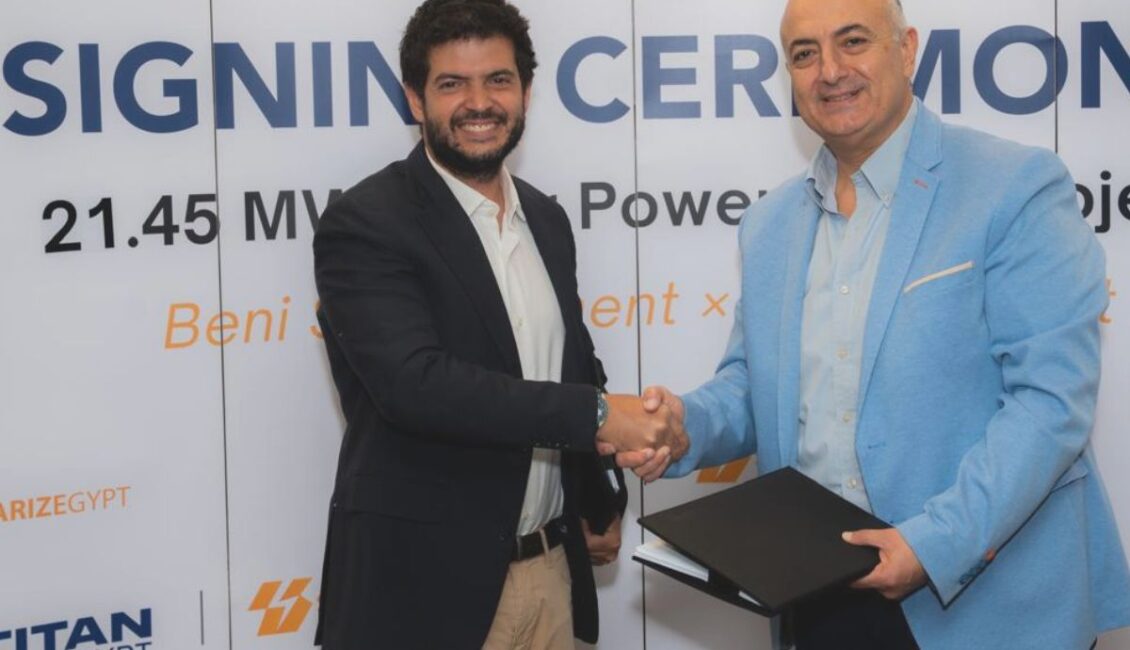
New agreement with SolarizEgypt lifts the plant’s total planned solar capacity to 21.45 MW
TITAN Egypt has signed a new agreement with SolarizEgypt to add 10 MW of solar power at its Beni Suef Cement Plant. The addition brings the plant’s total planned solar capacity to 21.45 MW, a significant step in the company’s decarbonization journey.
Cleaner energy for cement production
Cement is one of the most energy-intensive industries, so the way a plant sources its power has a direct effect on its environmental footprint. By expanding on-site renewable capacity, TITAN Egypt aims to raise the share of renewable energy in its operations and reduce its dependence on conventional energy sources.
The agreement reflects the company’s broader push toward more sustainable cement production, where cleaner energy is treated as an operational priority rather than a long-term aspiration.
A partnership-driven approach
The project is also an example of the collaboration needed to move industrial decarbonization forward. By working with SolarizEgypt, a company specializing in solar energy solutions, TITAN Egypt combines its industrial expertise with specialist renewable energy capabilities.
Through strategic partnerships and continued investment in cleaner energy, TITAN Egypt is turning its sustainability commitments into tangible action.

Supporting Egypt’s industrial transition
The expansion also supports Egypt’s wider transition toward more sustainable industrial manufacturing. As more energy-intensive producers adopt renewable power, the benefits extend beyond individual plants to the country’s industrial sector as a whole.
Register now to attend The Cementitious Materials International Technical & Trade Congress MEA taking place this December in Morocco, where you can obtain exclusive insights into the workings regional industry.
 Topics include:
Carbon-Neutral Cement Production
Explore MEA region-based initiatives for using SCMs in cement production and construction materials, with a focus on advanced carbon capture and utilization technologies and their economic viability and potentia for long-term cost savings
Next-Generation Cement Alternatives
Examine developments in geopolymer cements, magnesium binders, and novel clinker substitutes tailored for the MEA region market, alongside international adoption trends and performance standards
Supplementary Cementitious Materials (SCMs)
Optimize fly ash, slag, natural pozzolans, and emerging SCMs like calcined clays to meet the growing demand for eco-friendly infrastructure in the MEA region, while addressing global sourcing challenges and supply chain resilience
Localized Sustainability Case Studies
Transforming industrial waste streams into resources for sustainable cement production in the MEA region, with a spotlight on regional projects in Texas and lessons from global leaders in waste-to- resource practices.
Technological Advancements
Explore the role of AI-driven material design, digital twins for plant optimization, robotics, and advanced automation in revolutionizing production efficiency, safety,and predictive maintenance in MEA region cement plants, with insights into global trends and cybersecurity considerations
Sustainability at the Core
Learn about circular economy practices, alternative fuels (agricultural residues,municipal waste, biomass), and energy efficiency improvements driving sustainable cement production in MEA region cities and globally, including discussions on green hydrogen integration.
Emerging Trends
Bio-inspired innovations for self-healing concrete, smart concrete with embedded sensors, and climate-resilient solutions addressing challenges like extreme weather events and urban heat islands in the MEA region and abroad.
Subscribe to our newsletter and stay in touch with our upcoming events. Get an extra 20% off as well as extended early bird deadlines, here: www.industrylink.eu/#signupnow.